

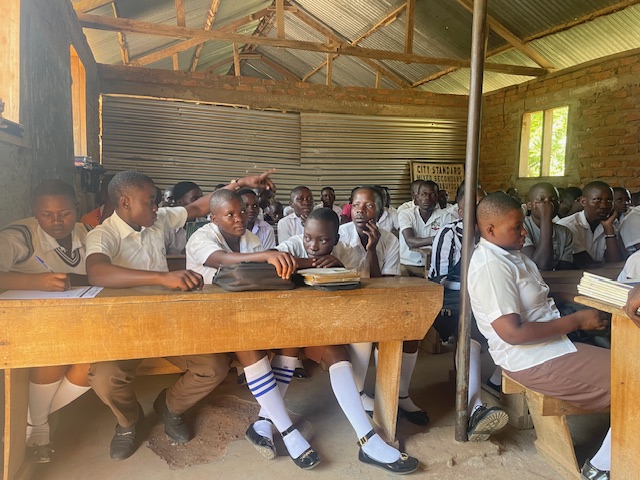
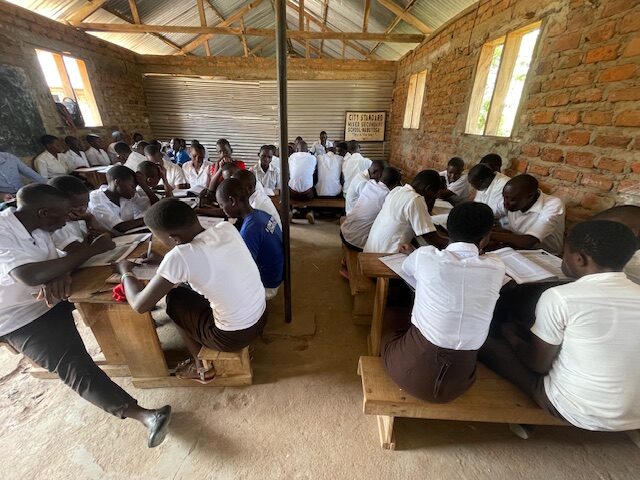
Let’s talk about the classroom in these photos for a second. The walls are made of bare-baked-earth bricks, packed with care by the hands of the community it serves. The window frames are empty, letting in the same breeze that has fanned the flames of curiosity for generations. There’s no electricity, no projector hum, no screen glow.
It’s one of the most beautiful and heartbreaking classrooms I’ve ever seen.
Beautiful, because its very existence is a testament to a community’s profound commitment to their children’s future. Heartbreaking, because in the 21st century, this is where the journey for digital equality in Africa often begins and, too often, ends.
The Ugandan government has set a bold, necessary vision with a new competency-based curriculum built for a digital world. International donors are investing in infrastructure. Yet, in the “last mile” villages, the gap between that national vision and the classroom reality can feel as wide as the empty window frame.
This is the quiet frontier of the digital divide. It’s not about a lack of policy or goodwill; it’s about the physics of mud bricks, the economics of rural electrification, and the logistics of reaching everyone, everywhere. The community has built the school. The government has designed the curriculum. The donors are seeking impact. But the students are waiting for a connection.
This is the puzzle we decided to solve. If the perfect, wired, and equipped computer laboratories can’t be built in every village tomorrow, what if they could travel? What if, instead of trying to rewire a continent overnight, we focused on bringing the connection to the community that already exists?
That’s the simple, rolling idea behind our work under the B.R.I.D.G.E.(Bridging Rural Innovation, Digital Growth & Education) project. We don’t see the mud-brick classroom as the end of the line. We see it as a starting point. Our B.R.I.D.G.E. Project is building mobile computer laboratory vans equipped with solar power, satellite internet, and a suite of computers that turn any schoolyard, under any tree, into a 21st-century laboratory.
We’re not replacing the government’s role; we’re ensuring its curriculum reaches every child. We’re not duplicating donor efforts; we’re offering a nimble, scalable model to multiply their impact. Most importantly, we’re partnering with the undeniable spirit of communities that have already built their schools from the ground up, literally. We’re just adding the wheels.
The path to digital equality isn’t just about building more permanent rooms with perfect wiring. Sometimes, it’s about meeting hope where it already lives, in a classroom of baked mud bricks and ambition—and making sure it has a satellite signal. The future isn’t just built from bricks and mortar; it’s built from connection, and we’re committed to driving that connection, one village at a time.

